5 Amazing Facts About Mountain Gorillas
Mountain gorillas are known as the second close relative of man after the chimps which shares almost 98% of human genes and it’s the largest member of the great ape family. An adult male silver-back, which age from 12 and above can weigh up to 470 pounds and can reach six feet in height.
Habitat
Mountain gorillas live in close-knit family groups that may have up to 30 members and the group consists of a dominant male called a silver-back because of the grey hair which grow around its back, the silver-back is responsible for any activity taking place in the group these include knowing where to sleep the following night, where to feed from, defends the group against any attack together with other males and even if meaning losing life a silver-back can do in order to defend the group. Other members in a family include few subordinate males and multiple females and infants.
Diet
Mountain gorillas are purely vegetarian mainly feed on plants, leaves, buds, shoots, tuber, stalks, fruits and ferns and sometimes aunts and rarely drink water since most of the food they eat comprises too much water.
Gestation Period
A female normally last with the pregnancy for about 8-10 months, they give birth for the first time at 10 years and will have more offspring’s every three or four years, they normally produce one child, twins are a herd of in life of gorillas.
Life Span
They live to up to 50 years in the wild; gorillas can live up to 50 years where as in captivity they may live less than 35 years
Population
By the time of writing, there about 1060 individuals left in two populations; Bwindi Forest in Uganda and the Virunga Massif that is shared by three countries Uganda, Rwanda and Democratic Republic of Congo
Threats to mountain gorillas
There major threats are human who practice deforestation to generate farmland, leaving them displaced. Poaching for trade meat and medicine is also another threat resulting into reduction in number. Also other wild animals like leopard also attack and kill them especially the young gorillas. The snares set for other animals kill gorillas. Let us work together for the survival of these endangered species by tracking/trekking them you are adding on their survival.
Read More5 Things I Learnt About Ringing Black Sparrowhawks
For the past three years I have been observing a pair of black sparrowhawks that nest just down the road from my family’s house in Tokai.
A couple of weeks ago I was invited by the Black Sparrowhawk Project to assist them in ringing three new chicks. Strangely, in the days leading up to the ringing, I had my best sparrowhawk sightings to date, including seeing chicks in a nest and their mother bringing them food. I was even able to watch the mother bring down a feral pigeon right in front of me.
The ringing itself was an incredibly enriching experience. I was able to witness new aspects of sparrowhawk behaviour, learn about their adaptations, and get an insight into what it takes for scientists to gain an understanding of these birds so that we can ensure their protection. Best of all, I was finally able to see the chicks up close after spending weeks barely glimpsing them in the nest.
Here are five things I learned about what is required to ring these magnificent birds.
1. Tree climbing
There are some serious risks involved in this part of the operation. At the start of each ringing, Mark Cowen had to climb up the tree with his climbing gear to reach the nest, photograph the chicks in the nest, put them in bags and lower them down to the other researchers on the ground. All the while, both parents repeatedly and relentlessly dive-bombed him. Sometimes the female would strike his helmet, resulting in a loud crack. The bombardment eventually got so bad that at one point Mark had to cover his helmet with a thick blanket for additional protection.
2. Taking blood samples
Dr. Petra Sumasgutner had to take blood samples from each of the three chicks. This is an essential element of the research because it allows her to look at the cell count of the birds, including blood cell count, and to determine whether or not the birds had any internal parasites or genetic problems. The institute has done a great deal of work in helping to increase our understanding about this population of black sparrowhawks.
3. The ringing
After the chicks had been weighed, each chick was fitted with three rings. One leg bears two of the rings and the other only one. A SAFRING, with a different number for each chick, is the primary ring fitted onto one of the chick’s legs along with a green and a blue ring. Each chick has a different ring combination so that they can be accurately identified in the future. These rings are an important tool in determining the range of individual sparrowhawks here, as well as population size.
4. Anatomy check
All three of the chicks are examined after the operations have been completed to determine what stage of growth they’re at, how developed their feathers are and whether or not they are displaying traces of hunger (which are side-effects from malnutrition that can lead to problems with the chicks’ development that could affect them in later life). Additionally, the chicks’ wings and facial features were photographed. It was amazing to be able to look at the features of these amazing birds from such close quarters. It really gave me a completely new perspective.
5. Getting up close and personal
I learned a lot of new things about black sparrowhawks while observing the chicks up close and watching the parents. Both the male and the female sparrowhawks had different calls to one another, which meant they could be accurately identified even when they were perched among thick branches. The legs and talons of the chicks were adapted for a life of specializing in hunting, and their eyes, which were light brown, would turn bright red when they were adult. I could also see the bird’s specialized trachea and watch as their claws reflexively grabbed at everything they saw.
Currently, all three chicks are doing well. They’ve lost all of their white fluffy feathers and are now no longer in the nest but perched in the branches of the nest tree with their parents. It won’t be long before they start hunting for themselves and leave their parents’ territory to start their own families.
Read More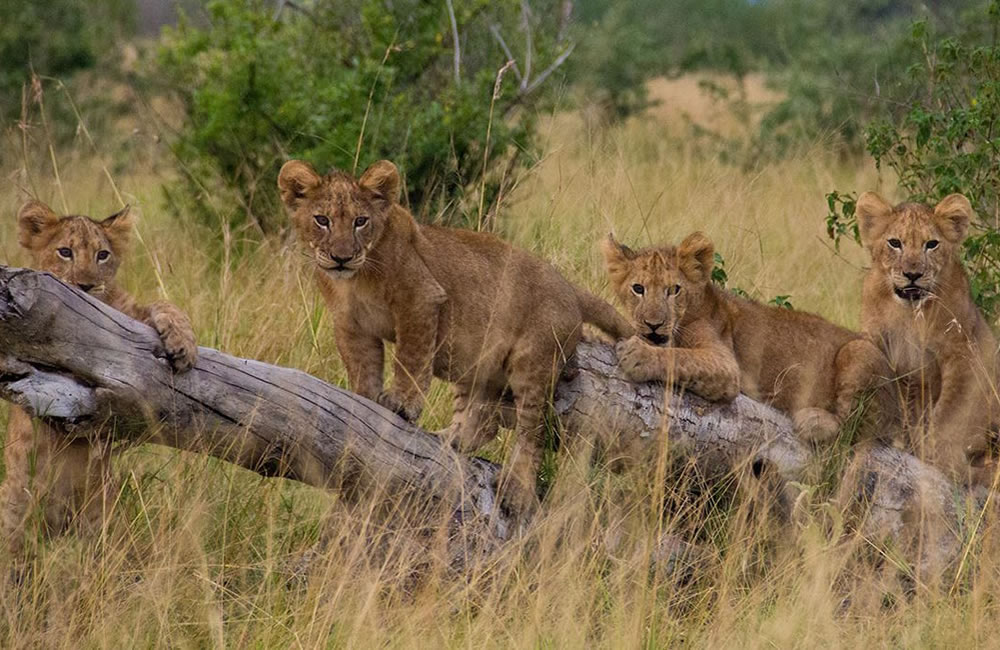
The Tree Climbing Lions of Uganda
Tree climbing lions are the highlights of most Uganda safaris to the Ishasha Sector of Queen Elizabeth National Park. Several tourists visit this East African country just to have a glance on these unique features of the pearl of Africa. The tree lions are the second most sought-after wildlife after the mountain gorillas that are looked for in the jungles of Bwindi or Mgahinga National Park, in south western Uganda.
Today most combined trips have been conducted, those that satisfy the hunger for both tree climbing lions and the forest giants; the mountain gorillas. You can have this amazing experience in just 4-6 days of adventure within Bwindi Impenetrable Forest and Queen Elizabeth National Park.
In the whole world, it is only Uganda’s Ishasha sector of Queen Elizabeth National park and Lake Manyara game reserve in southern Tanzania where you can see these lions that have mastered the art of climbing large trees. The parks that are both in East Africa protect a thriving population of lions that have adapted to hiding in the fig trees as they keenly look for the next prey. Tree Lion tracking is done from the vehicle given that these are predators. Encountering them within the minimum distance is possible and is such an experience that will not only be heart pounding but also memorable.
Being a reality in the world, lion tracking is one of the activities that Uganda’s tourism prides in. Over 50 tree climbing lions dwell in Ishasha sector. They mostly lie in the fig and acacia trees found here for shade during day time.
Yes, even if there some tree climbing lions in Lake Manyara game reserve in Tanzania, the most reliable location in the world to track the lions up in the trees is Ishasha sector, making it one of the must visit places while on a Uganda safari.
A place that gives tourists an overrated opportunity to spot tree climbing lions, not only cubs, but also the adult lions. Nothing beats watching these unique creatures climbing up a fig tree, or lying on the tree branches, an amazing sight that no tourist will ever get anywhere else except Ishasha sector, and sometimes Tanzania.
It is believed that these lions climb trees to protect themselves from the biting tsetse flies on the ground and to also escape from the ground and enjoy the cool breeze up in the trees. However, no specific reason has been proved as to why these lions climb trees unlike others.
The ever increasing population of climbing lions in Ishasha has made it a popular destination that offers an exceptional tree climbing lion tracking experiences. Trackers always watch the lions lazily lying up in the branches of huge fig trees, looking at the several Uganda kobs grazing on the plains of Ishasha. Uganda kobs are their main prey, it’s very hard for a day to go without a single lion grabbing a Uganda kob.
Visiting the ishasha plains doesn’t only reward trackers with thrilling encounters, but also sights of other wildlife species like the buffaloes, Uganda kobs, warthogs, elephants, and others since lion tracking involves driving through the flat plains, going off track so as just to have clear glances of these amazing features that Uganda beholds.
Note that other lions that don’t climb trees can also be spotted anywhere else in Queen Elizabeth national park. Still Murchison falls National Park and Kidepo valley national park are other areas where you can find a reasonable population of lions. These lions are mostly found in the savannah regions but can also be found in varied habitats including woodlands and desert.
Remember that lions are the only cats that can be described as truly social because they live in groups of 12–16 individuals called prides. A pride can have 4 – 6 related lionesses and their cubs, as well as 1–2 males who are usually with the pride for a breeding season that is 24-36months.
If you are a lion lover, and desire to have really up close encounters with lions in Africa, Uganda is the way to go. It can never go wrong on tree climbing lion tracking.
Read MoreOvergrazing Threatening Elephant Populations
In Kenya for the last few years, pastoral communities have had to endure losses worth thousands of dollars as long famine spells persisted. With scarce water and little pasture having been consumed by the scorching sun in the semi arid areas, pastoral communities witness their livestock starve until they drop dead.
As a result of this painful experience, the pastoralists had to think of viable survival means, which led them to the expansive wildlife ranches and reserves with plenty of grass. The danger from wild animals to the herders and their livestock was far outweighed by the much needed pasture.
The well fed livestock have reproduced and their population in this ranches and reserves increased leading to overgrazing. Though livestock has survived, the overgrazing has occasioned a new threat to the survival of other wild animals.
According to a new study published in an online journal, overgrazing by livestock poses a greater danger to elephants more than poaching. The six year study published in the Proceedings of the National Academy of Sciences suggests that climate change and human encroachment on wildlife space are threatening the already endangered elephant.
Thure Cerling, leader of the study carried out by the University of Utah says, “Fifteen years ago, there was a lot of poaching in the area, and elephants were getting killed, but since then, security has improved considerably, so people are moving in with cattle. Now there’s a suggestion the elephants are finding it harder to compete with the cattle than with the poachers.”
Following a family of three elephants in the Samburu and Buffalo Springs national reserves the team found that for the animals to reproduce, they need to alternate between eating a diet of grass and shrubs.
Two weeks after the rains begin, an elephant, the study says, usually switches to a grass diet to bulk up for pregnancy and birth. But the team observed that when seasons changed and there was prolonged drought or livestock had fed on the early grass, the elephants did not conceive.
The study also showed an intricate interplay in the timing of the rainy season, the growth of grass and when the elephants breed and give birth.
Five weeks after the rains start, when the proportion of grass in the elephants’ diet reaches maximum levels, females in the 800-member Samburu-Buffalo Springs elephant population are most likely to conceive.
The elephants give birth 22 months after conception, with the peak of births just in time for another rainy season to provide water and grass for offspring.
According to Cerling, the study leader “It is clear that the grass provides nutrients that the elephants presumably need for successful reproduction,”
The jumbo: Prized Ivory Still its Curse
A latest conservation study notes 681 of 701 elephant tusks sold in the US in 2007, came from Africa. The Study titled Ivory Markets in the US by conservationists Esmond Martin and Daniel Stiles say the quantity could be higher as it is difficult to track down the movement of ivory from Africa. Zimbabwe took the lead followed by Tanzania, South Africa and Botswana.
“Tusks from Africa are first sent to a third country; tracking the movement is very difficult,” says the report. This is the latest published data since the Convention on International Trade in Endangered Species of Wild Fauna and Flora (CITES) conference in The Hague, The Netherlands, allowed the Southern African elephant range states a one-off sale of their ivory stockpiles in 2007.
The partial downgrading of the elephant from the category of species threatened with extinction is perceived to have triggered an upsurge in poaching. However, going by recent developments in Kenya, the threat against the Jumbo’s does not stop there.
According to Kenya Government records, regions where Chinese contractors are building roads are prone to poaching. The Chinese embassy in Kenya complained of perceived ethnic profiling of their nationals following information by wildlife authorities in Kenya estimating that foreign contractors killed 80 elephants last year. Apart from China, other Ivory leading markets in the world include Japan and the US.
The upsurge in poaching is also blamed on lax surveillance and porous borders with Tanzania. “We have difficulties in protecting our wildlife species, especially the elephant and the rhino. Tanzania lacks the equipment and technical know-how to track their stocks. They are also indifferent to appeals for joint operations in game parks to keep poachers off. They believe their elephant stocks are stable, but their rhino numbers have declined to less than 40, which speaks volumes about the level surveillance,” a Kenya wildlife security officer, who declined to be identified, said.
Read More